
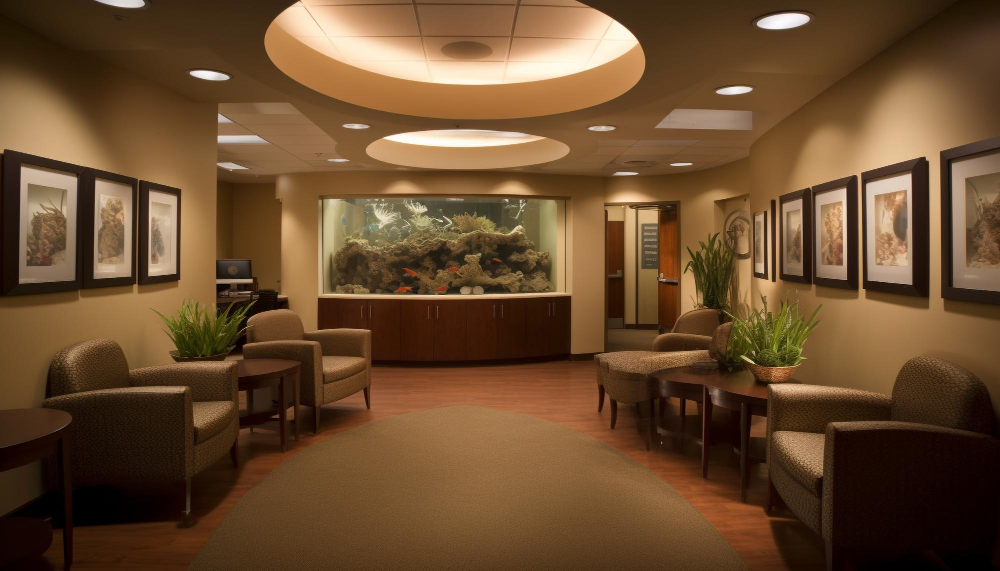
Behavioral health facilities rely on comfort, autonomy, and safety. These spaces are built to be welcoming and calming spaces that help minimize stigma and improve the effectiveness of therapy for the individual. One key aspect of this is how lighting influences the perception of these facilities and can impact patients’ general well-being during recovery and healing.
Why Lighting Matters in Behavioral Health Facilities
Responses to lighting stimuli is heightened for behavioral health patients. Natural lighting helps provide a more home-like feeling and helps the patients feel more at ease in a clinical setting. In patient’s room, artificial lights that are attuned to a person’s individual circadian rhythm helps promote a natural response to the transition from day to night. But not addressing these items can have disastrous effects for patients suffering from behavioral health illnesses.
Lighting, in most cases, make or break the patient’s experience in a healthcare setting. If psychotic patients are already agitated, the wrong lighting might produce episodes that cause injuries to patients or staff. On the other hand, geriatric patients, especially those with cataracts, are better able to function in lighting in environments with blue or cool lighting versus red or warm lighting.
Using Light to Influence Autonomy and Safety
Lighting has a huge role to play in behavioral health facilities as it enhances the space’s functionality. The lighting must be perfect to ensure that it is neither a triggering stress or a source of discomfort for the patients. There is no single lighting setting that satisfies a wide array of patients’ need, which is why it is important to have options to control the lighting intensity and spectrum in different environments that can be easily adjusted in a moment.
Whenever possible, patients, especially inpatients, should have some control over the lighting in the space where they spend their time. While the staff encourages patients to be out of the room through the day for therapy and socialization, sometimes patients need to spend time alone in their room. Hence, using lights that can be controlled by the patients without being a safety hazard is critical. The ability to control the lighting empowers the patient to personalize the environment, giving them some sense of control and allowing them to feel safer and more comfortable.
Incorporating Natural Elements into Lighting
Research has shown that using nature indoors helps improve patient well-being. The same also applies for behavioral healthcare settings where lights that mimic natural daylight help in circadian stimulus and body’s physical regulation.
As patients are often isolated without access to natural overload, the feel of lighting that replicates natural light is a critical factor in their recovery. By changing the intensity and spectral distribution of lighting to mimic the natural progression of daylight, healthcare spaces can become better aligned with patients’ natural circadian rhythm and help improve their overall well-being.
Addressing Staff Burnout
In addition to patient experience, healthcare facilities are striving to reduce the burden on the staff to improve retention and quality of care delivered. Mental healthcare environment specifically must provide lighting that is safe and intuitive to alleviate some of the pressure off healthcare workers.
Lighting for Crisis Management
Patients experiencing a mental health emergency often arrive in the emergency ward. However, these spaces might not always be welcoming and safe for someone who’s going through a mental health emergency. Hence, building specific emergency areas for patients with mental health issues is critical. This can be done through better use of lighting that is warm, comfortable, and helps in keeping the patient calm and safe. These considerations are in stark contrast of the harsh, often overwhelming environments found in traditional emergency departments around the country.
Quick Tips Mental Health Facility Lighting Solutions
-
- Exposure to daylight and outside views are central to creating an optimal environment for behaviour health patients.
- Maximize the use of natural light or lights that mimic the natural progression of the day.
- Mix different levels and types of artificial light to control and enable adjustments.
- Use LED lighting that is energy efficient as well as easily adjustable.
- Use recessed downlights to create a sense of calm.
- Cool hues are recommended for behaviour health facilities. Research has shown that blue light reduces violence and agitation and promotes healthy sleep patterns.
- Amber lights can be used for nighttime illumination in the rooms and corridors as well.
- It is important that the intensity of the lights match the interior, the wall colours and the overall ambience of the healthcare facility.
- Provide some level of control to the patients as that helps them feel a sense of autonomy.
Lighting Solutions for Your Health Facilities
-
- LED Dimmable Downlights for Hospitals India : Using harsh fixed bright lighting can heighten patient anxiety and agitation. Hence, in behavioral health settings, it is always suggested to use dimmable LED downlights that not only allow the staff to adjust the intensity throughout the day- brighter for therapy sessions, softer for rest hours- supporting circadian rhythms and emotional regulation, but also change the direction of the lights.
- Indirect Wall Lighting for Mental Health Rooms : Direct overhead lighting can feel very clinical and harsh for patients in psychiatric or rehabilitation wards. The use of indirect wall lights can be helpful as it creates a diffused glare-free glow that is calming and residential rather than institutional.
- LED Panel Lights for Healthcare Facilities : This light is best used for patient areas, group therapy rooms, and corridors which require consistent uniform illumination without flicker. LED panel lights deliver even light distribution across white spaces and they are energy efficient, which is critical for facilities running lights 24*7.
- Motion Sensor Lights for Hospital Corridors : Nighttime navigation in behavioral health facilities is quite a challenge as it needs to balance safety with sleep preservation. Here, the use of motion-activated LED lights can be helpful as it illuminates corridors only when needed, reducing unnecessary light exposure for sleeping patients while keeping other patients and staff safe.
- Bed Side Lights for Psychiatric Wards : Beside ambient lighting in mental health wards, there should also be a provision of bedside lighting that is soft, controllable, and ideally tamper-resistant. Switch bedside lightings allow patients a sense of autonomy and a comfort without overwhelming the room and can have a significant impact on patient well-being.
- LED Ceiling Lights for Clinics India : Outpatient clinics and counseling centers need professional lighting that’s clean and puts patients at ease. Surface-mounted LED ceiling lights offer a sleek, modern look with consistent warm or neutral white output that is ideal for consultation rooms and waiting areas. Hospital.
If you are looking to buy hospital lighting online India, The Light Kart has one of the largest selections of healthcare-grade lighting, from dimmable downlights to indirect wall fixtures, all available online with the best pricing, amazing quality, and pan-India delivery.
FAQs
Lighting for behavioral health facilities is critical as it plays an important role in regulating mood, sleep cycles, and overall emotional stability. Poor lighting can increase anxiety, agitation, and depression, thereby reducing the impact of the treatment on the individual. Well-designed mental health facility lighting solutions help stabilize the individual and improve long-term as well as short-term efficacy of the treatment.
The ideal colour in hospital lighting for psychiatric wards and behavioral health facilities or treatment centers ranges between:
- 2700K to 3000K (warm light) for relaxation areas and patient rooms
- 3500K to 4000K (neutral light) for activity and therapy spaces.
Dynamic LED lighting for healthcare facilities in India is increasingly used to mimic natural daylight cycles, support better sleep and recovery.
While there are no official lighting standards for behavioral health facilities, it generally follows the principles of:
- Adequate illumination without glare
- Anti-flicker and tamper-proof fixtures for safety
- Flicker-free lighting to prevent discomfort
- Circadian-friendly lighting design
- Compliance with healthcare lighting norms and safety regulations.
Modern mental health facility lighting solutions also emphasize energy efficiency and patient control.
Therapeutic lighting for mental health centers directly supports recovery as it improves sleep quality, reduces stress, enhances mood and emotional regulation, and supports cognitive functions.
Well-planned lighting for behavioral health facilities can shorten recovery time and improve overall patient outcomes.
Lighting design is not just functional but also has a therapeutic value. In hospital lighting for psychiatric wards and treatment centers, the right lighting:
- Creates a sense of safety and calm
- Minimizes triggers for patients
- Supports staff efficiency and observation
- Enhances the overall healing environment.
This is why LED lighting for healthcare facilities in India also integrates human-centered design principles.
Light therapy involves controlled exposure to specific light intensities at different wavelengths to treat mental health conditions like depression, anxiety, and sleep disorders. Research has found that lights that replicate daylight or sunlight have a huge therapeutic benefit as it tricks our brain and body into thinking that it is sunlight and regulate bodily functions. This has been particularly helpful for people who live in areas where winters are harsh and gloomy which leads them to suffer from seasonal affective disorder (SAD).
Light therapy is a key component of modern lighting for behavioral health facilities, especially in spaces with limited natural light.